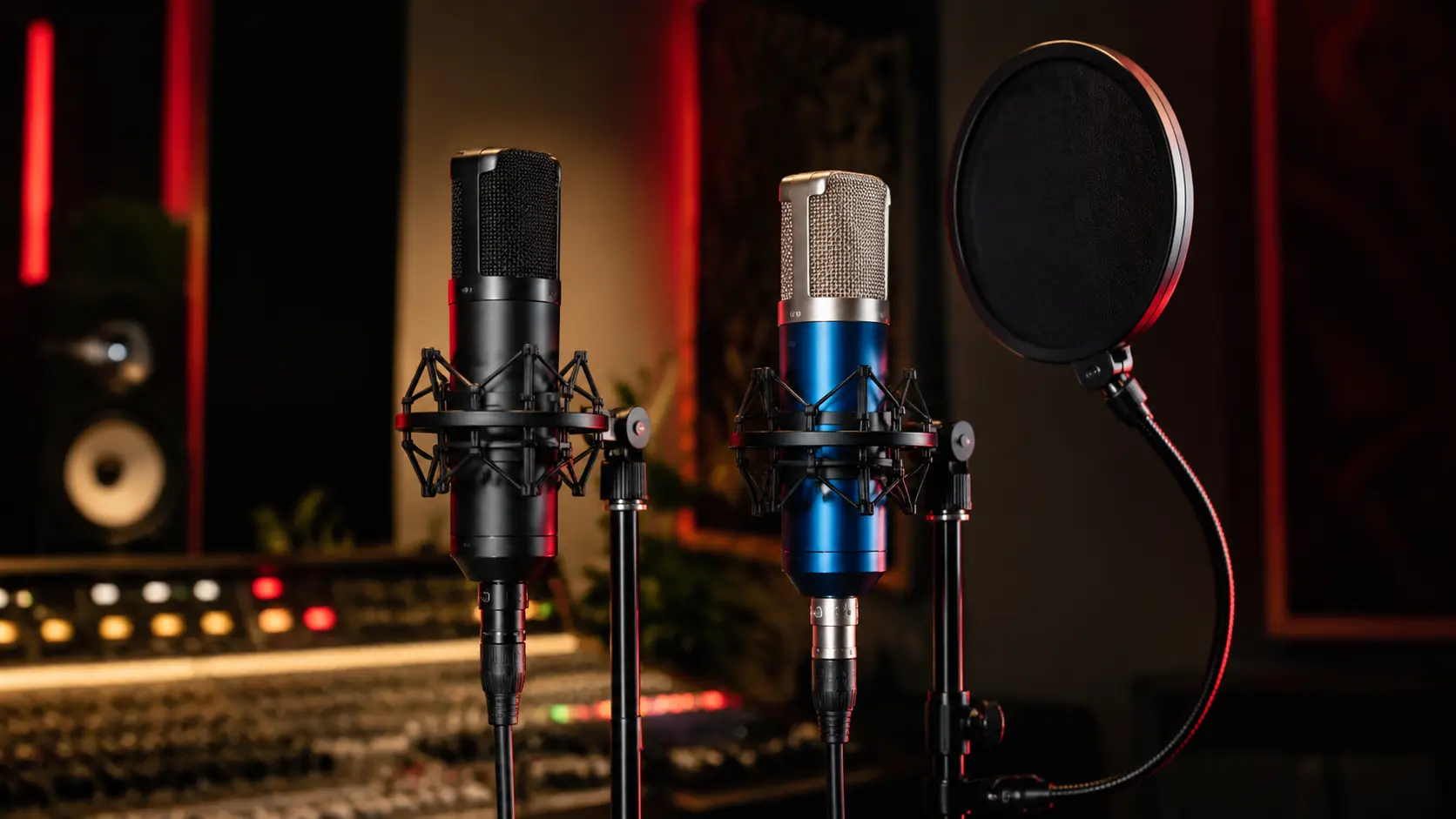
The Audio-Technica AT2020 is one of the most recommended beginner microphones on the internet.
For vocals, I think you can do better.
And if you already own one and keep trying to EQ the harshness out of your vocals, you might not be bad at EQ. Your microphone may be part of the problem.
Let’s give up the goods immediately.
If you’re about to spend around $100 on an AT2020 mainly to record vocals, look for a used Blue Bluebird SL first.
If they’re around the same price?
I’m taking the Bluebird.
Why?
Here’s the simple version.
The Bluebird is more sensitive, which basically means it gives your recording equipment a stronger signal to work with.
It also creates less noise of its own.
And it has two useful switches built into it: one can reduce low rumble, and the other helps when you’re recording something really loud.
Does any of that automatically mean it’ll sound better on your voice?
No.
But the Bluebird originally belonged to a more expensive class of microphones. Now that it’s discontinued, used ones sometimes show up around AT2020 prices.
That’s a hell of a deal.
So What’s Wrong With the AT2020?
Nothing.
And that’s important.
The AT2020 is affordable, durable and perfectly capable of making good recordings.
I just don’t love it as the automatic recommendation for vocals.
Every microphone changes the sound it hears a little bit.
The AT2020 can add some extra emphasis to the higher parts of a voice.
On the right singer, that can sound clear and crisp.
On an already bright voice?
SSSSSSSSSS.
Now every S sounds angry.
The vocal can start feeling thin or sharp, and the beginner does what beginners have been taught to do:
Open an EQ.
And Then the Plugin Olympics Begin
You cut some high frequencies.
Still harsh.
Add a de-esser to calm down the S sounds.
Now the vocal feels dull.
Add another EQ.
Maybe some saturation because YouTube said it’ll make things “warm.”
Forty-five minutes later, your vocal chain is capable of launching a satellite...
…and you still hate the recording.
Before adding plugin number seven, do this:
Turn everything off.
Listen to the vocal exactly as it was recorded.
Then ask yourself:
Do I actually like how my voice sounds?
If the answer is no, another plugin might not be the solution.
Sometimes your microphone just isn’t a great match for your voice.
That’s the Part Beginners Don’t Get Told
Microphones are a little like shoes.
A really good shoe can still fit your foot terribly.
Microphones work the same way.
One microphone might make my voice sound full and clear.
Put you in front of the exact same microphone and suddenly your S sounds could cut glass.
Neither of us is doing anything wrong.
The microphone simply reacts differently to different voices.
That’s why I don’t love telling every beginner:
“Just buy an AT2020.”
Why I’d Try the Bluebird SL
The Bluebird SL isn’t perfect either.
It can also sound bright, and on some singers it can bring out too much sibilance—that sharp S sound we’ve been talking about.
But for vocals, I generally prefer what I can get from it.
And if I can find one used around the price of a new AT2020?
Easy decision for me.
Bluebird first.
Not because a spec sheet says it’s magically better.
Because I’d rather start with a recording I like than spend the next hour trying to repair one I don’t.
Already Own an AT2020? Keep Your Credit Card in Your Pocket.
Don’t immediately sell it because some engineer on the internet has opinions.
Test it first.
Record yourself with no plugins.
Use a pop filter.
Try getting a little closer or farther away.
Try turning the microphone slightly instead of singing directly into the front of it.
And remember: your room matters too.
If you’re recording in a bedroom with bare walls, the microphone will hear some of that room bouncing back at it.
Your mic isn’t broken.
It has ears. Unfortunately, your bedroom has opinions.
Then listen again.
If the raw recording sounds good?
Congratulations.
Keep your AT2020.
Stop shopping.
Make music.
But if you’ve tried different positions, your room isn’t causing the problem, and your raw vocal still sounds thin, harsh or full of angry S sounds?
Try another microphone before buying another plugin.
So Should You Buy an AT2020?
Sure.
Just don’t buy one automatically because the internet told you it’s the “beginner microphone.”
If you’re mainly recording vocals and have around $100, check the used market.
If you find a Bluebird SL around that price, I’d absolutely consider it.
Better yet, listen to microphone tests using singers whose voices sound similar to yours.
Because the best microphone isn’t the one everybody recommends.
It’s the one you record with, play back and think:
“Cool. I can work with this.”
Instead of:
“Why the hell does every S sound like a snake fight?”
The Bottom Line
If your AT2020 vocals sound harsh, thin or overly sharp, don’t immediately start stacking EQs and de-essers.
Turn the plugins off.
Check your microphone position.
Check your room.
Listen to the raw recording.
If you still don’t like what you’re hearing?
Your microphone may simply be wrong for your voice.
And if you’re shopping around $100?
I’d look for a used Bluebird SL before automatically buying an AT2020.
Your EQ shouldn’t have to rescue your microphone.
Specifications referenced
Already own the AT2020? Here is the EQ map.
If you are keeping the mic and want a practical starting point instead of another plugin rabbit hole, I made a short companion guide: How to EQ an AT2020 Without Ruining Your Vocal. It covers the frequency ranges to investigate, harshness and sibilance fixes, thin and muddy vocal recipes, a simple vocal chain, and a 60-second diagnostic.